A Single New Jersey Ticket Won $847 Million. What Happens Next?
One ticket sold at Wegmans in Montvale, NJ, won $847 million. Cash take-home, anonymity, signing the ticket, and what ~$190M after tax can quietly do.
Jackpot Dreaming EditorialUpdated 11 min read
Published Nov. 7, 2026. Prize details checked against Powerball and the New Jersey Lottery. The selling retailer was confirmed in the Lottery's Nov. 5, 2026 press release. If you are holding that ticket, the sections on signing, anonymity, taxes and scams are meant for you first.
What we know about the winning ticket
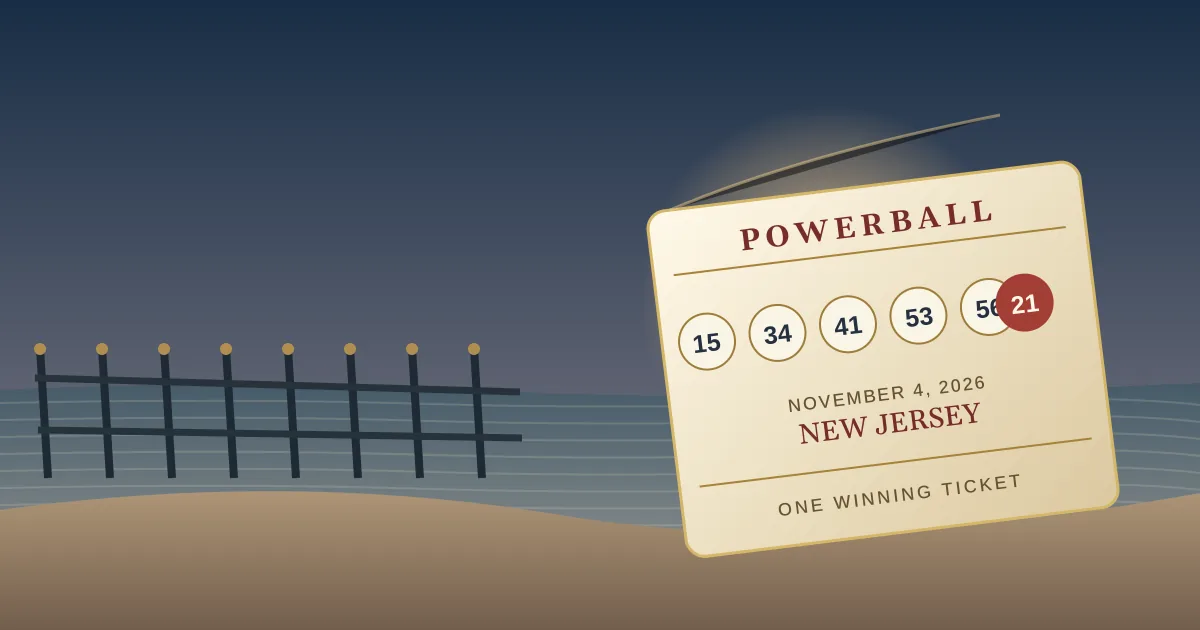
The winning numbers were 15, 34, 41, 53 and 56, with red Powerball 21. The Power Play multiplier was 2X. Power Play does not multiply the jackpot.
Powerball says one New Jersey ticket took the whole jackpot. It was the ninth-largest prize in the game's history and ended a run of 35 drawings without a jackpot winner. The jackpot resets to $20 million for Saturday, Nov. 7. You can see exactly where it lands, by headline, by cash value, and next to other split and unsplit prizes, on our 100 largest U.S. lottery jackpots list.
Where was it sold?
The New Jersey Lottery named the exact store on Nov. 5, 2026: Wegmans Food Market, 100 Farm View, Montvale, in Bergen County. The store gets a $30,000 bonus for selling the winning ticket. That is the official retailer release, not a rumor or a news paraphrase.
Winners in New Jersey have one year from the drawing to claim. For a prize this size, the Lottery says to call 1-800-222-0996 and claim by appointment (Lawrence Park Complex / headquarters guidance on the claim page). Jackpots are not a walk-up cash-out at Wegmans.
The town, by the numbers
Montvale is a borough in Bergen County. The 2020 Census counted 8,436 residents there. A Census figure is useful for scale, and it is not a ticket-buyer count. It includes children, people who never bought a ticket, and people who may not even have been in town on drawing night. Some buyers at that Wegmans may live elsewhere.
If you are holding the ticket: sign it, then slow down
The New Jersey Lottery's April 2026 Winner's Guide puts this at the top of the checklist: sign the back of your ticket, know what it is worth, photograph the front and back, and store the ticket somewhere safe. That is not optional color. The official Winner Claim Form says you must sign the back of the original ticket and the claim form, and that the name and signatures must match. Claims without a matching ticket signature are not processed.
Signing does not give up anonymity. It marks you as the owner if the ticket is lost, stolen or disputed, and it lines up with how New Jersey validates a claim. For a prize this size, do not leave an unsigned ticket in a glove box, a group chat screenshot, or a "friend's" pocket.
Photograph front and back after you sign. Keep the physical ticket until the Lottery tells you the claim is done. For prizes of about $100,000 or more, the Winner's Guide says to call 1-800-222-0996 and make an appointment to claim in person at Lottery headquarters in Lawrence Township.
None of that is legal advice. It is what New Jersey's own claim pages and Winner's Guide ask winners to do.
Can the New Jersey winner stay anonymous?
Yes. Under New Jersey law, holders of winning tickets may remain anonymous indefinitely. The Lottery's claim page and claim-form privacy policy say winners may choose not to have their identity released. The Winner's Guide is blunt about it: your identity is not made available to the public unless you agree in writing to allow it. The Lottery does not release your name to the press or to curious neighbors.
Anonymity is not the same as invisibility to the government. To file a claim you still present proper identification for Lottery processing and for reporting to the IRS and the New Jersey Division of Taxation. The claim form also has an anonymity waiver box. Checking "yes" knowingly waives anonymity and can allow the Lottery to use your name, town and state, prize amount and likeness for advertising. Leaving that waiver alone is how you keep the default.
What the Lottery will still disclose publicly: that winning tickets were sold or claimed, the game, the prize amount, the retailer who sold the ticket, and the town where it was sold. So Wegmans and Montvale are public even when the winner is not.
If you want to stay private after a win this large, the Lottery's own tip is to keep the circle small and tell only the people you trust most. A trust or other legal setup is a question for your own lawyer. The Lottery says it cannot advise on those constructs.
How much would the winner actually keep?
The winner can choose the $847 million annuity, paid in 30 increasing payments over 29 years, or the one-time $363.1 million cash option. Here is the cash option using our after-tax calculator, with 2026 federal brackets and New Jersey's top rate:
| Cash prize math | Estimate |
|---|---|
| Cash option before tax | $363,100,000 |
| Federal income tax | $134,297,000 |
| New Jersey income tax | $39,033,250 |
| Kept after estimated tax | $189,769,750 |
That assumes a single filer, no other income, the 2026 standard deduction and a New Jersey prize taxed at the state's top 10.75% rate. Our calculator applies that top rate to the whole prize, which slightly overstates the state bill on the first $1 million. Actual tax depends on the winner's circumstances and the rules when they claim.
There is an important difference between tax owed and tax withheld. Federal withholding is 24%, or $87.144 million. New Jersey withholding is 8% on a prize this size, or $29.048 million. Subtracting both leaves about $246.908 million in the first check. The estimated final tax bill is another $57.138 million beyond that withholding.
In other words, "the government takes 32%" is withholding, not the whole story. Our estimate puts the combined final tax at about 47.7% of the cash prize.
Cash or annuity, without the sales pitch
Neither choice is automatically "smarter." The cash option is one taxable year of a large income, paid after claim processing. The annuity is 30 payments over 29 years, which spreads income and can change how you plan gifts, investments and future tax law. Groups can claim a term annuity with separate checks, per New Jersey's claim FAQs. The Lottery recommends professional tax and financial help on large prizes and does not refer winners to specific advisers.
Our job here is the after-tax math and the official claim rules, not to talk anyone into a product.
Scams, sudden friends, and what can wait
A jackpot this size attracts people who want a cut before you have even claimed. Common patterns: strangers who "found" your ticket, relatives who want an advance, investment pitches that cannot wait until after taxes, and anyone asking you to wire money, share photos of an unsigned ticket, or meet in a parking lot to "verify" the win.
The Lottery will not ask you to pay a fee to collect. Official claim contact is through njlottery.com and 1-800-222-0996. Until the ticket is signed, copied, secured and claimed on your timeline, almost every urgent ask can wait. Paying off debt, funding family priorities and setting aside the remaining tax bill beat a shopping spree on day one.
What are the odds that the winner is you?
Before the drawing, each $2 play had a 1 in 292,201,338 chance of winning the jackpot. Buying a ticket in New Jersey did not change that. Neither did buying it at that Wegmans.
Once officials name a town, it is tempting to divide one by its population and call that the chance a local ticket-buyer is the winner. That would be wrong. Population counts children, visitors and people who never bought a ticket, while some buyers may live elsewhere.
If a town had B actual ticket-buyers who each bought one equally likely play, and exactly one local buyer held the sole winning play, then a randomly selected buyer from that group would be 1 in B. But the retailer announcement does not tell us B. It also does not prove the winner lives in Montvale.
For illustration only: if there were 1,000 local buyers, one would be 1 in 1,000. At 10,000 buyers, one in 10,000. Those are hypothetical group shares after a win, not the odds of picking the winning numbers and not estimates for Montvale.
What could that money do?
These are options, not advice. An estimated $189.8 million after tax is large enough that the first moves can stay boring and still matter.
- Clear housing pressure for good. Paying off a mortgage, covering rent for years, or helping family get stable housing is often more useful on day one than a trophy purchase. The median owner-occupied home value in Montvale borough was about $710,000 in recent Census figures, so housing math here is real, not abstract.
- Fund education and family priorities on a quiet schedule. College, caregiving, and multi-generational support can be planned without a press conference. Even 1% of the estimated after-tax cash is about $1.9 million.
- Invest the rest in a boring, diversified way. Broad index funds and a written plan beat a rush of "hot" deals. That is a framing, not a product pitch, and a fiduciary adviser can help size it to the remaining tax bill.
- Support parks and outdoor time close to home. Montvale Recreation runs borough fields and programs, and Bergen County's park system covers nearly 9,000 acres with trails, lakes and historic sites. A gift or endowment for local recreation is one way to keep money useful without turning the winner into a public spectacle.
Secure the ticket, keep quiet, and hire an independent tax adviser, lawyer and fiduciary financial planner before making promises. The Lottery itself recommends professional help on a prize this size.
The part that does not change
Somebody beat extraordinary odds. That does not make the next ticket luckier, and it does not turn the store into a better place to buy one. The odds reset with the jackpot.
If you play, use fun money, not the rent or grocery budget. And if you are holding the winning ticket: sign it, photograph it, keep it somewhere secure, stay anonymous unless you choose otherwise, and get professional advice before claiming.
FAQ
Where was the $847 million Powerball ticket sold?
At Wegmans Food Market, 100 Farm View, Montvale, in Bergen County, New Jersey, according to the New Jersey Lottery's Nov. 5, 2026 press release. The store receives a $30,000 selling bonus. It was the sole jackpot-winning ticket for that drawing.
How much does the New Jersey winner keep after taxes?
For the $363.1 million cash option, our calculator estimates about $189.8 million after federal and New Jersey income tax for a single filer with no other income. That is an estimate, not a quote of the winner's actual tax bill.
What were the winning Powerball numbers for Nov. 4, 2026?
The white balls were 15, 34, 41, 53 and 56. The red Powerball was 21, and Power Play was 2X.
Should the winner sign the back of the ticket?
Yes, according to New Jersey Lottery guidance. The Winner's Guide lists signing the back of the ticket as the first checklist step. The claim form requires a signature on the original ticket that matches the claim form. Signing helps prove ownership; it does not waive anonymity.
Can the New Jersey Powerball winner stay anonymous?
Yes. New Jersey law and the Lottery's claim pages say winners may remain anonymous indefinitely unless they waive that right in writing. The Lottery still collects claim identification and reports to the IRS and state tax authorities. It will also name the selling retailer and town even when the winner stays private.
Does living in the winning ticket's town mean you had better odds?
No. Every Powerball play had the same 1 in 292,201,338 jackpot odds. The retailer's location does not tell us who bought the ticket, where that person lives, or how many people in town played.
Sources
Powerball, Nov. 4, 2026 draw result: numbers 15, 34, 41, 53, 56 and Powerball 21; Power Play 2X; one grand-prize winner in New Jersey.
Powerball, "Single Ticket Wins $847 Million Powerball Jackpot in New Jersey": one New Jersey winner; $847 million advertised prize; $363.1 million cash; ninth-largest Powerball jackpot; 30 payments over 29 years; next jackpot $20 million.
New Jersey Lottery, "New Jersey Lottery Ticket Wins $847 Million Powerball Jackpot" (Nov. 5, 2026): sole winning ticket sold at Wegmans Food Market, 100 Farm View, Montvale, Bergen County; $30,000 retailer bonus; one-year claim deadline from the drawing; sign the ticket immediately.
U.S. Census Bureau QuickFacts, Montvale borough, New Jersey: population, Census April 1, 2020: 8,436; median owner-occupied home value (2020–2024 ACS): $709,700.
Montvale Recreation: borough parks, fields and recreation programs.
Bergen County outdoor activities / parks: nearly 9,000 acres of county parks, trails and recreation sites.
New Jersey Lottery Powerball odds and prizes: $2 per play and jackpot odds of 1 in 292,201,338.
New Jersey Lottery, Claim a Prize / Tax Requirements: sign the ticket; claim paths by prize size; jackpot / large-prize appointment guidance; winners may remain anonymous; ID still required for IRS reporting; N.J.S.A. 5:9-1 et seq.
New Jersey Lottery Winner's Guide (April 2026 PDF): checklist to sign the ticket, photograph it and store it safely; claim by mail or appointment for large prizes; anonymity unless waived in writing; public disclosure limited to game, prize, retailer and town sold.
New Jersey Lottery Claim Form Privacy Policy: winners may remain anonymous indefinitely; identity choosing anonymity is not public under OPRA; IRS and debt-offset disclosures still apply.
New Jersey Lottery Winner Claim Form instructions: must sign back of original ticket and claim form; signatures must match; anonymity waiver is optional (Box 14).
New Jersey Division of Taxation, Lottery and Gambling Winnings: New Jersey Lottery prizes over $10,000 are taxable; 8% withholding on lottery payouts over $500,000.
New Jersey Division of Taxation, income-tax rates: official state rate schedules, including the 10.75% top marginal rate.
IRS 2026 inflation adjustments and IRS Forms W-2G and 5754 instructions: 2026 federal brackets and standard deduction; 24% withholding on qualifying lottery winnings.
Jackpot Dreaming calculator: after-tax and withholding estimates for the $363.1 million New Jersey cash option.