How Often Is a Powerball Ticket Worth 75 Cents on the Dollar?
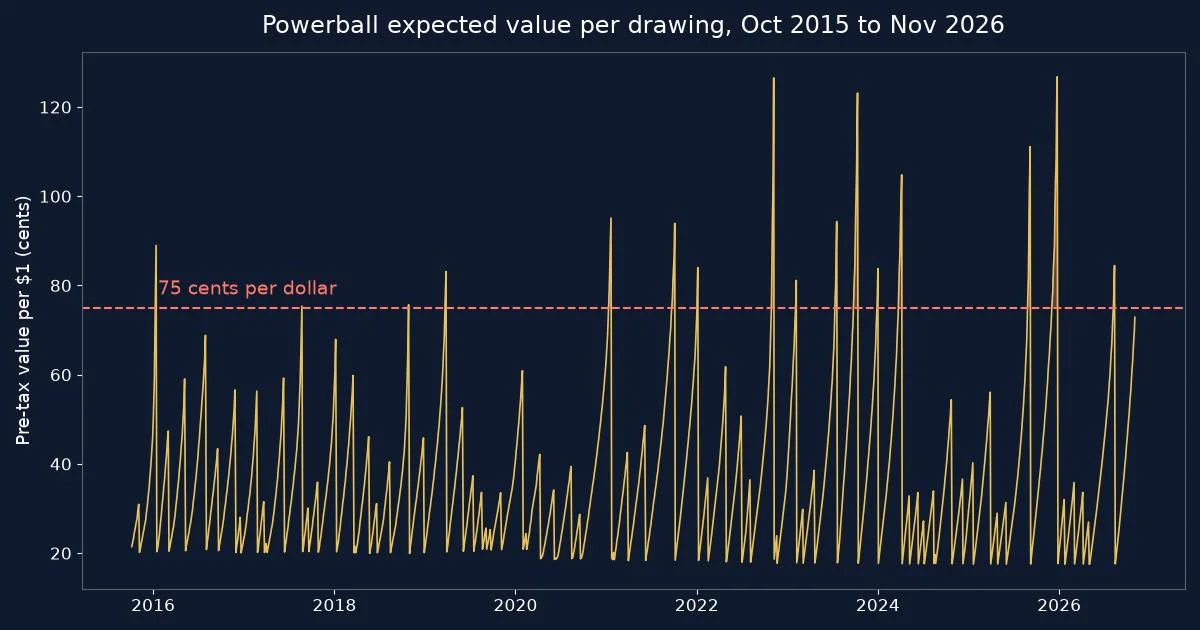
We ran every Powerball drawing since October 2015 through our expected-value math. A $2 ticket hit 75 cents per dollar, pre-tax, in 60 of 1,428 drawings.
Jackpot Dreaming EditorialUpdated 7 min read
The big caveat: that value is not spread evenly
Of tonight's roughly 75 cents per dollar, only about 16 cents comes from the smaller prizes ($4 up to $1 million). The other 59 cents or so is the jackpot, and you only collect it by beating odds of 1 in 292,201,338. That's the whole catch. On almost every ticket you'll get back $0 or a few dollars, and the 75-cent "average" only exists because of a prize that nearly nobody wins.
Jackpot figures are the official estimates from powerball.com and megamillions.com, checked Nov. 4, 2026. Tonight's drawing hasn't happened yet and the jackpot can move before it does. Jackpot Dreaming isn't affiliated with Powerball or any lottery.
First, what "75 cents on the dollar" means
Expected value is the average amount a ticket pays back if you could play the same drawing millions of times. A ticket with an expected value of $1.50 on a $2 price "returns" 75 cents for every dollar, on average. In real life you almost always get $0, sometimes $4, and once in a very long while a lot more.
Our after-tax calculator works it out the same way every time:
- The small prizes. Every Powerball tier from $4 up to $1 million, weighted by its official odds. That's worth about 32 cents per $2 ticket, and it never changes.
- The jackpot. The cash value divided by the 1 in 292,201,338 odds.
- The chance you'd have to share. We estimate how many tickets were sold from how much the cash jackpot grew since the last drawing, then figure the odds someone else also hits. Bigger crowds mean a smaller average slice.
The jackpot piece is the only part that moves, so the whole question is how big the cash value has to get. Keep in mind it's also the part almost nobody collects.
How big the jackpot needs to be
For the small prizes plus the jackpot to reach $1.50, the jackpot share has to cover about $1.18. If nobody else could possibly win, that takes about $345 million in cash.
But somebody else can win, and the bigger the jackpot, the more people play. At 50 million tickets a drawing you need about $375 million cash. At 200 million tickets it's about $476 million. That's why the 75-cent line usually shows up somewhere past $800 million advertised these days.
It wasn't always that high. Interest rates matter here because they set how big the advertised annuity looks next to the cash. In January 2021, when rates were near zero, a $557 million jackpot already had a $416.4 million cash value, and that was enough. In 2026, $835 million gets you $357.9 million cash.
How often it actually happened
We pulled the official result page for every Powerball drawing on powerball.com, from Oct. 7, 2015 through Nov. 2, 2026, and ran each one through the same math as the calculator.
| Year | Drawings at 75¢+ | All drawings |
|---|---|---|
| 2015 (from Oct. 7) | 0 | 25 |
| 2016 | 1 | 105 |
| 2017 | 1 | 104 |
| 2018 | 1 | 104 |
| 2019 | 2 | 104 |
| 2020 | 0 | 105 |
| 2021 | 8 | 123 |
| 2022 | 7 | 157 |
| 2023 | 15 | 156 |
| 2024 | 7 | 157 |
| 2025 | 15 | 157 |
| 2026 (through Nov. 2) | 3 | 131 |
| Total | 60 | 1,428 |
A few things jump out.
It's gotten more common. Before 2021 it happened five times in about four and a half years. Since 2023 it's happened 40 times in 601 drawings, about 6.7%. Part of that is Monday drawings (added in August 2021), and part of it is that runs to $1 billion+ just happen more often now.
It comes in bunches. The 60 drawings belong to only 16 runs. Once a jackpot crosses the line it tends to stay over it until someone wins, so you'll see four or five in a row and then nothing for a year or more.
A record jackpot isn't automatically the best deal. The $1.586 billion drawing on Jan. 13, 2016 only comes out at about 89 cents in our math. Ticket sales were so huge that sharing was likely, and it was in fact split three ways. The best drawings by our estimate were the $2.04 billion on Nov. 7, 2022 and the $1.817 billion on Dec. 24, 2025, both about $1.27 per dollar before taxes. Those are also the two largest advertised Powerball wins on our 100 largest U.S. lottery jackpots list, which ranks the same official history by cash value and by each winning ticket's share.
That last part sounds wild, and it deserves a caveat. In 12 drawings our pre-tax number went above $1.00 per dollar. After taxes, none of those come out ahead for a typical winner, and the sales estimate behind the split odds is our own estimate, not an official figure.
What about Mega Millions?
Mega Millions went to a $5 ticket on April 8, 2025, with a built-in multiplier on the smaller prizes. Those smaller prizes are worth more (about $1.12 per ticket), but you need $3.75 of value to reach 75 cents per dollar on a $5 ticket. That takes something like $764 million in cash even if nobody else could win, and realistically $830 million or more.
We checked all 165 Mega Millions drawings from April 8, 2025 through Nov. 3, 2026 on megamillions.com. None reached 75 cents. The closest was the $980 million jackpot on Nov. 14, 2025 ($452.2 million cash), at about 52 cents per dollar.
We didn't fold the old $2 Mega Millions (2017 to early 2025) into this. Its prize table and multiplier worked differently, and we'd rather leave it out than guess.
The tax part, which matters a lot
Everything above is before taxes, because that's how expected value is usually quoted. Your real number is a lot worse.
A jackpot or $1 million prize is taxed as ordinary income. For a jackpot winner, that's almost all at the top federal rate of 37%. If you knock 37% off tonight's jackpot and the two biggest fixed prizes, a $2 ticket drops from about $1.50 to roughly $1.01. That's about 51 cents per dollar, and that's before any state tax. Smaller prizes count as taxable income too, even when no tax form comes with them.
You can plug tonight's jackpot and your state into our calculator to see your own after-tax take.
So, is tonight a "good" drawing?
By lottery standards, yes. At about 75 cents per dollar pre-tax, it's in the top 5% of drawings since 2015. Just remember where that 75 cents lives. About 16 cents of it is the small prizes, and the rest is the jackpot, which you only see if you beat the 1 in 292,201,338 odds. By any other standard, no. You're still giving up a quarter of every dollar on average before taxes, and about half after.
Our guess, and it is only a guess: if nobody wins tonight, Saturday's cash value will probably push the pre-tax number into the high 70s or low 80s.
If you play, play an amount you'd happily spend on a night out. The expected value doesn't change how unlikely the jackpot is: 1 in 292.2 million, every single time.
How we checked this
- Jackpot and cash values: the official result page on powerball.com for each drawing date, and megamillions.com's drawing data for each Mega Millions date. We spot-checked against state lottery releases, for example the Arkansas Scholarship Lottery for the Dec. 24, 2025 jackpot ($834.9 million cash) and the Maryland Lottery's detailed results for Aug. 12, 2026 ($450.5 million cash).
- Prizes and odds: the official Powerball prize chart and Mega Millions game rules.
- Ticket sales: estimated from the drawing-to-drawing growth of the cash jackpot. Powerball puts about 34% of each $2 sale into the jackpot. As a sanity check, Maryland's published count of "Powerball only" winners on Aug. 12, 2026 implies about 82 million plays. Our estimate was about 71 million, so if anything we're a little light on sharing.
- Small changes don't change the story. Moving the line to 74 or 76 cents gives 61 or 52 drawings.